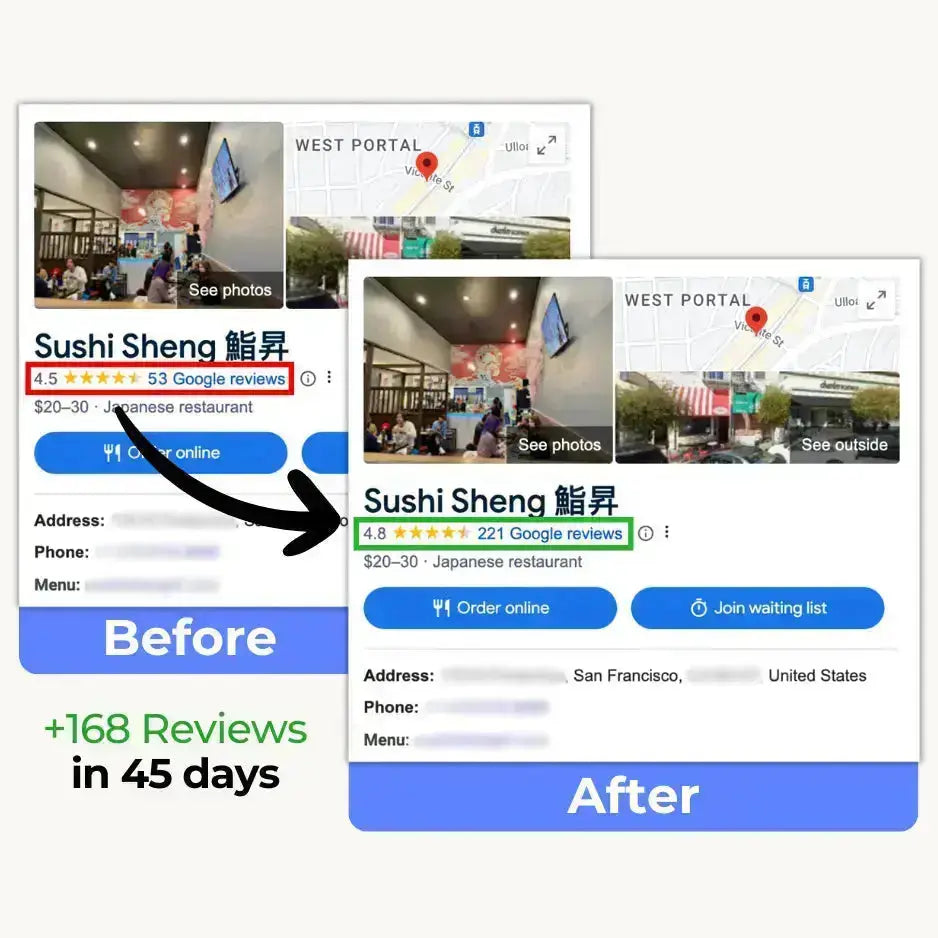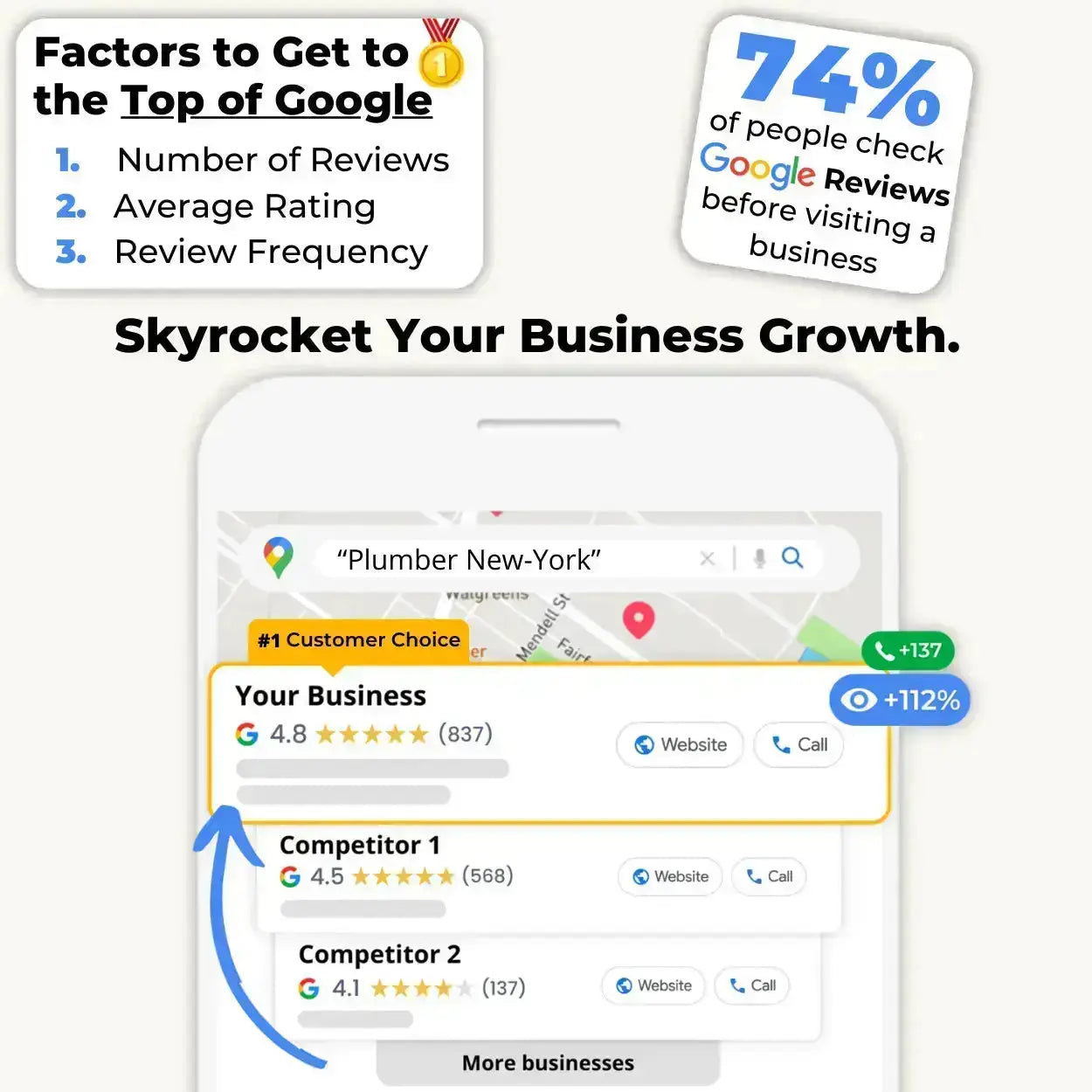
If you have ever wondered why a competitor with a smaller business, a less prominent location, and a smaller marketing budget consistently outranks you in local Google search results the answer is almost certainly sitting in their review profile.
Google reviews are not just a trust signal for potential customers. They are a direct, measurable ranking factor that Google's local search algorithm uses to determine which businesses deserve the most visibility in local search results, Google Maps, and the coveted local pack the three business listings that appear at the top of the page before any organic results for location-based searches.
In 2026, the relationship between your Google review profile and your local search ranking has never been more direct or more consequential. Businesses that understand this relationship and manage their reviews strategically are consistently outperforming competitors who have better websites, larger budgets, and longer operating histories simply because they have cracked the code on what Google's algorithm actually rewards at the local level.
The mechanics of how reviews influence your ranking go deeper than most business owners realize. It is not just about having a high star rating or a large number of reviews. Review velocity, review recency, keyword content within reviews, response rate, and response speed all feed into how Google evaluates your profile's authority and relevance for local search queries in your category.
In this article, we break down exactly how Google reviews impact your local SEO ranking and what you can do right now to leverage your review profile as the most powerful and cost-effective local SEO tool available to your business in 2026.
Why Google Treats Reviews as a Local Ranking Signal?
To understand why Google treats reviews as a local ranking signal, you need to understand what Google is fundamentally trying to do every time someone performs a local search. When a user types "best dentist near me" or "Italian restaurant open now," Google's entire objective is to surface the most relevant, trustworthy, and high-quality business options available in that location. Reviews are the most direct, authentic, and scalable signal Google has access to for evaluating all three of those dimensions simultaneously.
Think about what a review actually represents from Google's perspective. It is an unsolicited, publicly published statement from a real customer who visited a real business and chose to share their experience. At scale, across thousands of reviews and hundreds of businesses in the same category and location, that body of customer feedback becomes one of the most reliable datasets Google has for distinguishing genuinely good businesses from mediocre ones. No business can fake consistent five-star reviews from verified Google users over an extended period which is precisely why Google weights them so heavily as a quality and relevance signal.
Google's local search algorithm evaluates businesses across three primary dimensions when determining local search rankings: relevance, distance, and prominence. Reviews play a direct role in two of these three dimensions in ways that most business owners do not fully appreciate.
Relevance is the degree to which a business matches the intent of a specific search query. Most business owners understand that their business category, profile completeness, and keyword usage contribute to relevance but fewer realize that the text content of customer reviews also feeds into relevance signals. When customers consistently use specific terms in their reviews mentioning particular services, products, or experiences Google indexes that language and uses it to determine which searches the business is relevant for. A restaurant whose reviews repeatedly mention "gluten-free options" will begin appearing in searches for gluten-free restaurants in that area, even if the business has never explicitly optimized for that term on their profile.
Prominence is the dimension of Google's ranking framework most directly influenced by reviews. Prominence refers to how well-known and well-regarded a business is and Google uses review volume, average star rating, review recency, and response rate as primary data points for evaluating it. A business with 300 recent, high-quality reviews that are consistently responded to signals a level of market prominence and customer validation that Google's algorithm interprets as a strong indicator of a business worth surfacing prominently in local search results.
Review recency deserves particular emphasis within this framework. Google does not treat a review from three years ago with the same weight as a review from last week. Fresh reviews signal an actively operating business with a current customer base and Google rewards that recency signal with improved local search visibility. This is why consistent review collection is more valuable than periodic bursts of review activity because a steady stream of recent feedback maintains the recency signal that keeps your ranking elevated over time.
The Specific Review Factors That Influence Your Local Search Ranking
Understanding that reviews influence local search rankings is one thing. Understanding which specific review factors carry the most weight and why is what allows you to build a review strategy that deliberately targets the signals Google rewards most. Here is a breakdown of the key factors that matter most.
Review Volume
The total number of reviews your business has accumulated is one of the most visible and consistently weighted factors in Google's local ranking algorithm. All else being equal, a business with 250 reviews will outrank a business with 25 reviews in the same category and location because review volume is a direct proxy for market validation at scale. The more customers who have publicly endorsed your business, the more confident Google is in surfacing it prominently to future searchers. This is why building a consistent, ongoing review collection habit is more strategically valuable than any single burst of review activity.
Review Recency
Google does not treat all reviews equally regardless of when they were published. A review submitted last week carries significantly more ranking weight than one submitted two years ago because recency is a signal of current operational status, active customer engagement, and ongoing quality. A business that collected 100 reviews three years ago and has added nothing since is sending a very different signal to Google's algorithm than one collecting five to ten new reviews every month consistently. Review recency is the factor that makes ongoing collection a non-negotiable discipline rather than a one-time priority.
Average Star Rating
Your overall star rating is one of the first data points Google uses to assess business quality and it influences both your ranking position and your click-through rate from search results simultaneously. A business with a 4.8 star average will consistently outperform one with a 3.9 average in local search visibility, all other factors being equal. More importantly, the star rating displayed on your profile is the first thing potential customers see before reading a single word of feedback making it a conversion variable as much as a ranking signal.
Review Responses
Google explicitly rewards businesses that respond to their reviews with improved local search visibility and the response rate and response speed of your profile both feed into how Google evaluates your engagement level. Responding to reviews signals to Google that your profile is actively managed, which is interpreted as a mark of a legitimate, customer-focused business worth ranking prominently. Aim to respond to every review within 24 hours positive and negative and make each response specific enough to demonstrate genuine engagement rather than copy-pasted templates.
Keyword Content Within Reviews
This is the most underappreciated review ranking factor of all. When customers use specific service terms, product names, or location references in their review text, Google indexes that language and uses it to expand the range of searches your profile is considered relevant for. A beauty salon whose reviews repeatedly mention "keratin treatment" or "balayage" will begin appearing in local searches for those specific services driven entirely by the organic keyword content of customer reviews rather than any deliberate optimization effort on the business's part. Encouraging detailed, specific reviews from your customers is therefore both a quality signal and a keyword strategy simultaneously.
How to Use Your Review Strategy to Outrank Competitors in Local Search?
Understanding that reviews influence your local search ranking is valuable context. Having a deliberate, systematic strategy to leverage that influence against your specific competitors is what actually moves the needle. Here is exactly how to build a review strategy designed not just to collect feedback but to systematically outrank the businesses competing for the same local search visibility you are.
The first step is conducting a clear-eyed competitive review audit. Before optimizing your own review profile, you need to understand precisely what you are competing against. Search your primary service keywords on Google, identify the businesses consistently appearing in the local pack above your listing, and analyze their review profiles in detail. How many reviews do they have? What is their average star rating? How recently were their most recent reviews published? How consistently are they responding? This audit gives you a concrete benchmark specific, measurable targets that define exactly what your review profile needs to achieve to close the ranking gap between your current position and theirs.
Once you understand the competitive landscape, the priority becomes velocity. If your nearest competitor has 150 reviews and you have 40, closing that gap requires a consistent, high-volume collection strategy sustained over time not a single push that generates 20 reviews in a week and then stalls. Google rewards sustained collection momentum over time far more than it rewards periodic bursts. The businesses that outrank their competitors in review volume are almost always those that have made review collection a standard operational habit rather than an occasional marketing initiative.
The most effective tool for building that collection velocity in a physical business environment is the Digifeel NFC Google Review Card. By eliminating the friction between a satisfied customer and a published review reducing the entire process to a single tap at the peak moment of their experience the Digifeel card allows businesses to collect reviews at a rate that manual methods simply cannot match. Restaurants, salons, clinics, and retail stores that integrate the card into their standard customer farewell routine consistently report review collection rates that outpace their competitors within weeks of adoption.
Beyond volume, review recency is the ranking factor you can influence most immediately. Even if a competitor has significantly more total reviews than you, a business that is consistently collecting five to ten new reviews per week will outperform one whose review activity has stalled because Google weights recent feedback more heavily than historical volume. This means that a disciplined, ongoing collection strategy can begin closing the ranking gap with a higher-volume competitor faster than most business owners expect.
Your response strategy is the final lever in a competitive review approach and one of the most frequently neglected. Responding to every review, within 24 hours, with a specific and genuine reply sends a consistent activity signal to Google that compounds your ranking advantage over time. Competitors who collect reviews but never respond are leaving a measurable ranking signal on the table and every response you publish is a small but real advantage that accumulates into a significant visibility differential over months of consistent execution.
The businesses that dominate local search results in competitive categories in 2026 are not necessarily the largest, the oldest, or the best funded. They are the ones that have built the most deliberate, consistent, and strategically executed review profile in their market and maintained it with enough discipline to stay ahead of every competitor trying to catch up.