It is the question every business owner asks the moment a damaging review lands on their profile. A one-star rating from someone you have never served. A fabricated complaint from what looks like a competitor's account. A scathing review from a customer whose issue was resolved months ago but who never updated their feedback. And sitting there, visible to every potential customer who searches for your business, pulling down your average rating and influencing purchasing decisions every single day.
The instinct is immediate: can I just delete it?
The honest answer is that the control businesses have over their Google reviews is significantly more limited than most owners assume and understanding exactly where those limits are, what options genuinely exist within them, and how to manage your review profile strategically within Google's framework is one of the most important reputation management skills a business owner can develop in 2026.
Google's review system was built on a foundational principle: consumer trust depends on review authenticity. If businesses could delete any review they disliked, the entire value of Google reviews as a purchasing decision tool would collapse overnight. Google knows this and the platform's policies reflect it with a deliberate asymmetry that gives reviewers significantly more direct control over published content than the businesses being reviewed.
But limited control does not mean no control. There are specific, legitimate circumstances under which reviews can be removed, a formal process for requesting that removal, and a set of strategic responses available to business owners that when executed correctly can neutralize the impact of negative reviews far more effectively than deletion ever could.
In this article, we break down exactly what businesses can and cannot do about their Google reviews in 2026 so you can stop wasting time on approaches that will never work and start focusing on the strategies that actually protect and strengthen your online reputation.
The Truth About Business Control Over Google Reviews
Let's be direct about something that a surprising number of business owners discover only after spending hours searching for a solution that does not exist: you cannot delete a Google review simply because you want it gone. No amount of reporting, appealing, or contacting Google support will result in the removal of a review that does not violate a specific Google content policy regardless of how unfair, inaccurate, or damaging that review might be to your business.
This is not a gap in Google's system. It is a deliberate design decision that sits at the core of what makes Google reviews valuable in the first place. A review platform where businesses can remove negative feedback at will is not a review platform it is a marketing brochure. Google understands this, and the asymmetry between reviewer control and business control over published content is intentional, permanent, and unlikely to change in any meaningful way.
What businesses can do falls into two distinct categories: removal through policy violation reporting, and reputation management through strategic response.
The first category removal through policy violation reporting is the only legitimate path to getting a specific review taken down from your profile. Google maintains a set of content policies that all reviews must comply with, and reviews that clearly violate those policies are eligible to be flagged and potentially removed by Google's moderation team. Reviews containing spam, fake content, hate speech, personal information, off-topic content, or clear evidence of a coordinated attack are all potential candidates for removal through this process.
The critical word here is "potentially." Flagging a review does not guarantee its removal. Google's moderation team evaluates each report individually, and the threshold for removal is a clear, demonstrable policy violation not a business owner's subjective assessment of unfairness. Reviews that are simply negative, exaggerated, or one-sided will almost always remain on your profile regardless of how many times they are reported.
The second category reputation management through strategic response is where businesses actually have meaningful and consistent control. How you respond to reviews, how quickly you respond, and the tone and substance of those responses are entirely within your control and have a direct, measurable impact on how potential customers perceive both the review itself and your business as a whole.
A well-crafted response to a negative review does something that deletion never could: it demonstrates your character publicly. Potential customers reading a one-star review followed by a calm, professional, solution-oriented response from the business owner are not just seeing a complaint they are seeing evidence of how your business handles adversity. That evidence is often more persuasive than the negative review itself, and businesses that consistently respond with professionalism and genuine care for customer experience consistently convert more profile visitors into customers than those whose negative reviews sit unanswered.
The truth about business control over Google reviews is straightforward: your power lies not in deletion but in response and response, executed correctly, is a more powerful reputation management tool than deletion ever was.
Which Google Reviews Can Actually Be Removed?
While businesses cannot delete reviews at will, Google does remove reviews that violate its content policies and understanding exactly which types of reviews qualify for removal is the difference between a reporting strategy that succeeds and one that wastes your time. Here is a precise breakdown of the review categories that Google will genuinely consider removing when properly reported.
Fake and spam reviews are the category most commonly flagged by business owners and for good reason. A review submitted by someone who has never visited your business, interacted with your team, or purchased your product is by definition not a genuine customer experience and Google's policies explicitly prohibit this type of content. Reviews that appear to have been written by competitors, by people with a personal grievance unrelated to a commercial transaction, or by accounts created specifically to leave negative feedback with no other activity history are all potential candidates for removal under Google's spam and fake content policy. The challenge is that Google requires evidence of inauthenticity a review that simply seems suspicious without demonstrable proof of fabrication is more difficult to remove than one where the inauthenticity is clearly provable.
Offensive and hateful content represents a more clear-cut removal category. Reviews containing hate speech, explicit language, discriminatory content, or personal attacks that cross into harassment territory violate Google's policies unambiguously and reports flagging this type of content tend to be processed more predictably than those involving suspected fake reviews. If a review contains language that would be considered offensive by reasonable community standards, flag it immediately with the "offensive or inappropriate" category selected in the reporting interface.
Reviews containing personal information are eligible for removal under Google's privacy policies. If a review includes the full name, phone number, email address, or any other personally identifiable information about a staff member, another customer, or any individual connected to your business, that review violates Google's content guidelines and can be reported for removal on privacy grounds.
Off-topic and irrelevant content covers reviews that have no genuine connection to a customer experience with your specific business. A review that describes an experience at a different business entirely, a review that is clearly about a different location within the same chain, or a review whose content bears no relationship to any service or product your business actually offers all fall into this category. These reviews are often the result of mistaken identity the reviewer intended to review a different business and Google is generally responsive to removal requests in these cases when the off-topic nature of the content is clearly demonstrated.
Conflict of interest content includes reviews written by current or former employees, by business owners reviewing their own business, or by competitors writing negative reviews to damage a rival's reputation. Google prohibits reviews that represent a clear conflict of interest and while proving this type of violation can be challenging, cases where the connection between the reviewer and the business is demonstrable through public information represent legitimate grounds for a removal request.
Conclusion
The answer to whether businesses can delete Google reviews is clear — and so is the strategic path forward once you accept it.
Direct deletion is not an option. Google's review system was designed to protect consumer trust, and that design places the power of deletion firmly in the hands of reviewers rather than businesses. No dashboard setting, no support escalation, and no amount of reporting will remove a review that does not clearly violate a specific Google content policy — and the sooner a business owner accepts this reality, the sooner they can redirect their energy toward the strategies that actually work.
Those strategies are twofold. First, use the reporting process correctly — not as a reflexive response to every negative review, but as a targeted tool deployed when a review demonstrably violates Google's content policies. Fake reviews, spam, offensive content, personal information, and clear conflicts of interest all represent legitimate grounds for removal requests. Building a clear, evidence-supported case before filing a report significantly improves the likelihood of a successful outcome.
Second, and more importantly, invest in your response strategy. How you respond to reviews — positive and negative — is entirely within your control and has a direct, measurable impact on how potential customers perceive your business. A professional, empathetic, solution-oriented response to a negative review does something deletion never could: it demonstrates your character publicly and turns a piece of damaging content into evidence of your commitment to customer experience.
But the most powerful long-term answer to negative reviews is not response management — it is volume. A business with 300 recent, high-quality five-star reviews is not seriously harmed by a handful of one-star outliers. The negative reviews get buried, the overall rating remains strong, and the sheer weight of positive social proof overwhelms any individual piece of critical feedback.
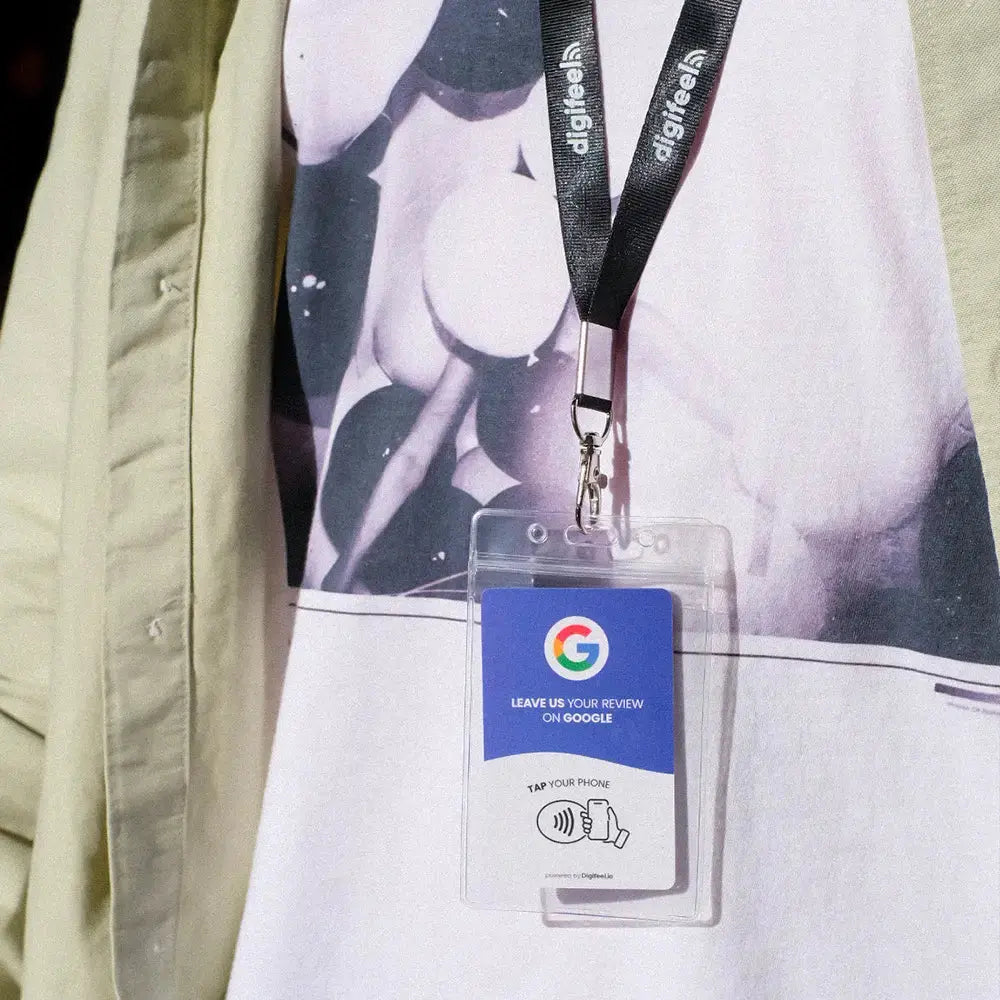
This is where the Digifeel NFC Google Review Card becomes your most strategic asset. By eliminating the friction between a satisfied customer and a published five-star review reducing the entire process to a single tap at the peak moment of their experience Digifeel gives your business the tool it needs to build the kind of review volume that makes negative reviews irrelevant rather than damaging.
You cannot control what every customer says about your business. But you can control how consistently you collect positive feedback from the customers who love what you do and in 2026, that consistency is the foundation of a Google review profile that no single negative review can meaningfully undermine.